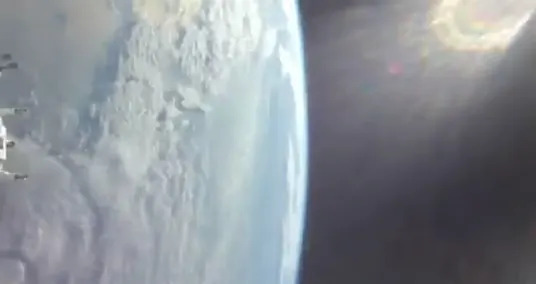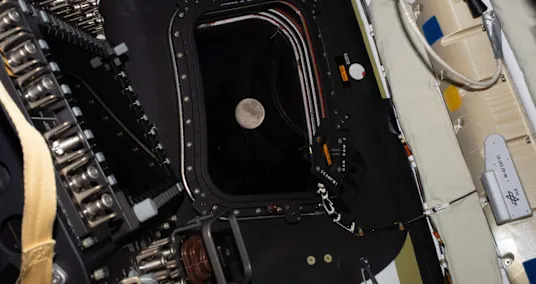
HOUSTON (AP) — With the moon looming ever larger, the Artemis II astronauts raced to set a new distance record Monday from Earth on a lunar fly-around promising magnificent views of the far side never seen before by eye.
The six-hour flyby is the highlight of NASA's first return to the moon since the Apollo era with three Americans and one Canadian — a step toward landing boot prints near the moon's south pole in just two years.
A prize — and bragging rights — awaits Artemis II.
Less than an hour before kicking off the fly-around and intense lunar observations, the four astronauts were set to become the most distant humans in history, surpassing the distance record of 248,655 miles (400,171 kilometers) set by Apollo 13 in April 1970.
Mission Control expected Artemis II to surpass that record by more than 4,100 miles (6,600 kilometers).
Artemis II is using the same maneuver that Apollo 13 did after its “Houston, we’ve had a problem” oxygen tank explosion wiped out any hope of a moon landing.
Known as a free-return lunar trajectory, this no-stopping-to-land route takes advantage of Earth and the moon’s gravity, reducing the need for fuel. It’s a celestial figure-eight that will put the astronauts on course for home, once they emerge from behind the moon Monday evening.
Commander Reid Wiseman, pilot Victor Glover, Christina Koch and Canada’s Jeremy Hansen were on track to pass as close as 4,070 miles (6,550 kilometers) to the moon, as their Orion capsule whips past it, hangs a U-turn and then heads back toward Earth. It will take them four days to get back, with a splashdown in the Pacific concluding their test flight on Friday.
Wiseman and his crew spent years studying lunar geography to prepare for the big event, adding solar eclipses to their repertoire during the past few weeks. By launching last Wednesday, they ensured themselves of a total solar eclipse from their vantage point behind the moon, courtesy of the cosmos.
Topping their science target list: Orientale Basin, a sprawling impact basin with three concentric rings, the outermost of which stretches nearly 600 miles (950 kilometers) across.
Other sightseeing goals: the Apollo 12 and 14 landing sites from 1969 and 1971, respectively, as well as fringes of the south polar region, the preferred locale for future touchdowns. Farther afield, Mercury, Venus, Mars and Saturn — not to mention Earth — will be visible.
Their moon mentor, NASA geologist Kelsey Young, expects thousands of pictures.
“People all over the world connect with the moon. This is something that every single person on this planet can understand and connect with,” she said on the eve of the flyby, wearing eclipse earrings.
Artemis II is NASA’s first astronaut moonshot since Apollo 17 in 1972. It sets the stage for next year’s Artemis III, which will see another Orion crew practice docking with lunar landers in orbit around Earth. The culminating moon landing by two astronauts near the moon’s south pole will follow on Artemis IV in 2028.
While Artemis II may be taking Apollo 13’s path, it’s most reminiscent of Apollo 8 and humanity’s first lunar visitors who orbited the moon on Christmas Eve 1968 and read from the Book of Genesis.
Glover said flying to the moon during Christianity’s Holy Week brought home for him “the beauty of creation.” Earth is an oasis amid “a whole bunch of nothing, this thing we call the universe” where humanity exists as one, he observed over the weekend.
“This is an opportunity for us to remember where we are, who we are, and that we are the same thing and that we’ve got to get through this together,” Glover said, clasping hands with his crewmates.
___
The Associated Press Health and Science Department receives support from the Howard Hughes Medical Institute’s Department of Science Education and the Robert Wood Johnson Foundation. The AP is solely responsible for all content.
LATEST POSTS
- 1
 Historic underwater structure discovered by divers off French coast
 - 2Step by step instructions to Keep up with the Life span of Your Kona SUV's Battery Duration
- 3Russia patents space station designed to generate artificial gravity
- 4Computerized Strengthening d: A Survey of \Upgrading Efficiency\ Programming Application
- 5National health ranking puts Georgia near bottom of list. Here's why


- Cyprus urges hotels to open up, pours funding into tourism
- Novo Nordisk justifies reasoning behind failed GLP-1 Alzheimer's trials
- Brazil judge orders government to add JBS subsidiary to 'dirty list' for slavery
- These 3 Nail-Free Finds Completely Transformed My Drab Bathroom
- Grasping the Commencement of Criminal Cases: An Extensive Outline
- 19 Peculiar Films You Shouldn't Watch With Your Mum
- Artemis 2 astronauts head for the moon after make-or-break engine burn (video)
- Brazil passes anti-gang law allowing seized crypto to fund security forces
- FDA official discusses potential link between COVID-19 vaccines and pediatric deaths